White Castle Slider: The Steam Grill Method
- Why Are White Castle Sliders Steamed Instead of Grilled?
White Castle sliders don’t look like any other burger in fast food. They’re small, square, weirdly soft, and they have five holes punched through the patty. They also taste completely different from anything else in the QSR world — and that’s not an accident. It’s the result of a cooking method that White Castle has been using since the 1920s: steam-grilling.
Most people assume that burgers are either grilled or fried. White Castle does neither. Their sliders are cooked on a bed of rehydrated onions using steam that rises through perforated patties, cooking the meat from both sides simultaneously. No flipping. No pressing. No char marks. Just steam, onions, and a process that hasn’t fundamentally changed in over 100 years.
I’ve spent a decade in QSR kitchens, and the White Castle method remains one of the most unusual and efficient cooking systems I’ve ever seen. Here’s exactly how it works.
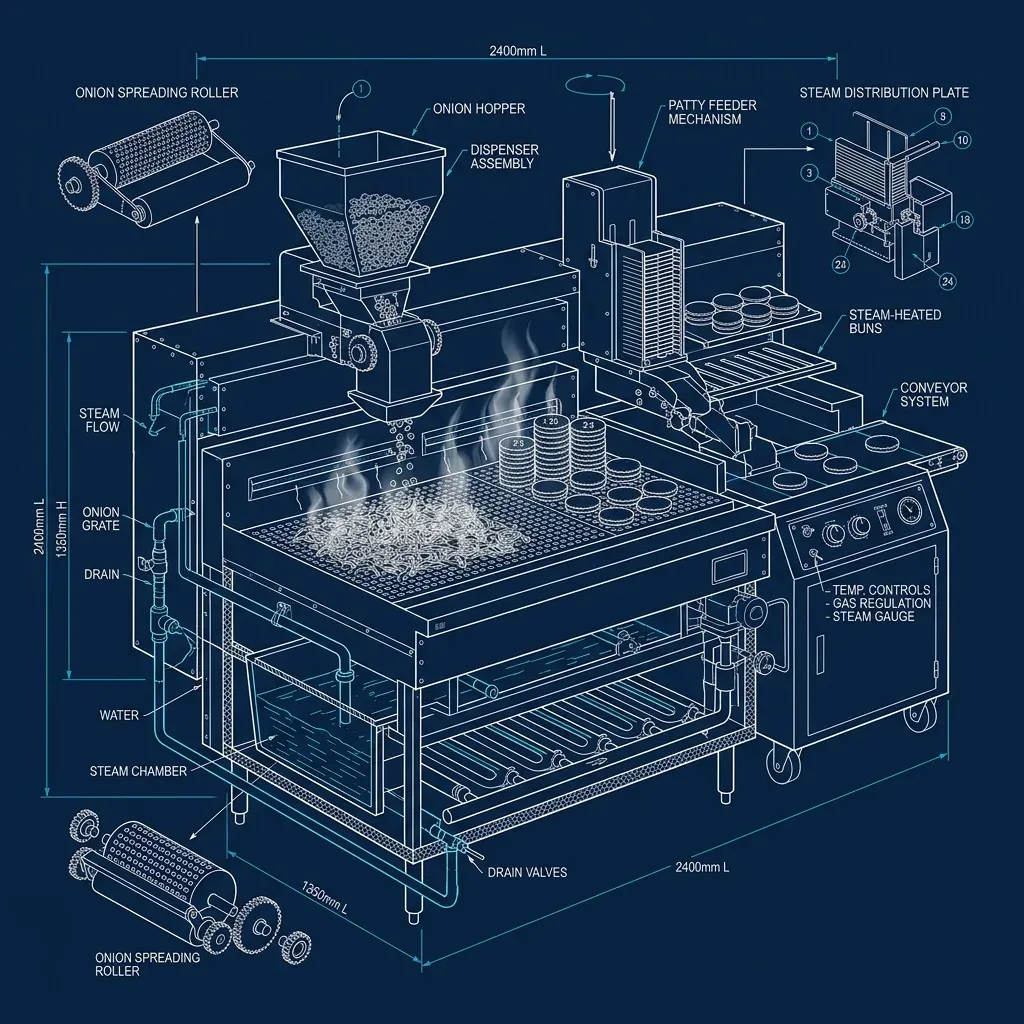
The Grill and the Onion Bed
Russell’s Note: When your KDS screen is going red on a Friday night, the last thing you want is a broken line. You have to run a 120-second window or you’re dead in the water.
Russell’s Note: Any BOH veteran will tell you: the walk-in cooler is the only soundproof place to take a 30-second mental break when the KDS screen is totally full.
The cooking surface at White Castle is a flat-top griddle, similar to what you’d find at most burger chains. The grill runs at a lower temperature than a typical QSR flat-top — roughly 275°F to 325°F, depending on the specific equipment and location. This lower temperature is intentional. White Castle isn’t searing their patties. They’re steaming them.
The process starts with dehydrated onions. White Castle uses commercially produced dehydrated onion pieces — small, dried fragments of white onion that arrive in bulk bags. These dehydrated onions are rehydrated with water and spread across the cooking surface in a thin, even layer. The onion bed covers the section of the grill where the sliders will cook.
The amount of onion matters. The layer needs to be thick enough to produce steam when water is added but thin enough that the onions aren’t clumping into mounds that prevent even heat distribution. The target is a uniform layer about a quarter-inch deep across the cooking area.
This onion bed serves three purposes:
-
It creates a flavor base. The onions are cooking directly on the hot griddle, releasing their natural sugars and aromatic compounds. Every slider that cooks on top of this bed absorbs onion flavor from below.
-
It produces steam. When water is added to the grill, the combination of hot metal surface, wet onions, and heat creates a steady supply of steam that rises up through the patties.
-
It prevents sticking. The moist onion layer acts as a natural non-stick surface between the beef patty and the griddle. Without the onion bed, the thin patties would stick to the flat-top and tear when removed.
Why Dehydrated Onions? The WWII Connection
There’s a genuinely interesting historical reason why White Castle uses dehydrated onions instead of fresh ones. During World War II, fresh onions became scarce due to supply chain disruptions and rationing. White Castle switched to dehydrated onions out of necessity — they were shelf-stable, took up less storage space, and could be sourced more reliably during wartime.
After the war ended and fresh onions became available again, White Castle discovered that their customers had grown to prefer the flavor of the rehydrated version. Dehydrated onions, when rehydrated and cooked, have a slightly different flavor profile than fresh onions. They’re sweeter, more concentrated, and they break down more uniformly during cooking. The texture is softer and more integrated into the slider rather than sitting on top as a distinct topping.
So White Castle kept using them. What started as a wartime substitution became a permanent part of the recipe, and the dehydrated onions are now inseparable from the White Castle slider identity. It’s one of those cases where a limitation forced a change that turned out to be better than the original.
The Five-Hole Patty
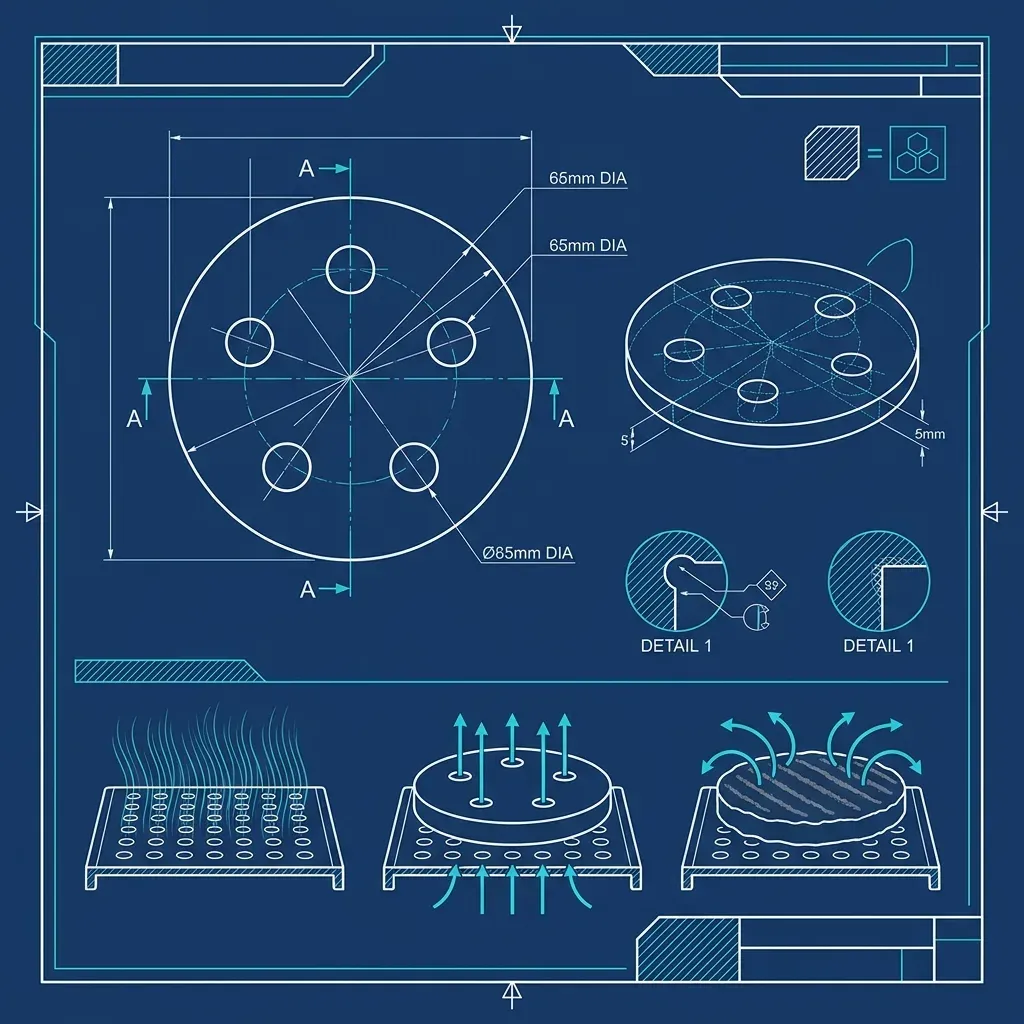
This is the most visually distinctive feature of a White Castle slider, and it’s also the most functionally important part of the entire cooking process.
White Castle beef patties are thin, square, and frozen. Each patty has five holes punched through it — one in the center and four arranged around it in a rough pattern. The patties are roughly 2.5 inches square and noticeably thinner than what you’d find at any other burger chain. We’re talking about a patty that’s maybe a quarter-inch thick at most.
The five holes are not decorative. They’re structural.
When the patties are laid on top of the onion bed, those holes create channels for steam to pass through from below. As water is added to the grill and steam rises from the onion layer, it travels upward through those five holes and cooks the top surface of the patty from below. Simultaneously, the bottom of the patty is cooking from direct contact with the onion bed and the griddle heat beneath it.
This means the patty cooks from both sides at the same time without ever being flipped.
Let that sink in. In every other burger operation in the QSR industry, patties are either flipped manually, pressed with a clamshell grill, or cooked under a broiler with heat from above. White Castle achieves bilateral cooking through holes in the meat and steam. It’s mechanically simple but thermodynamically clever.
The holes also solve a problem with thin patties: curling. When a thin beef patty hits a hot surface, the edges tend to curl upward as the proteins contract unevenly. The holes relieve internal tension in the patty, allowing it to lay flat on the griddle throughout the cooking process. No curling means even cooking across the entire surface.
Patty Composition
White Castle’s beef patties are 100% beef — no fillers, no extenders, no soy protein. The meat is formed, perforated, and flash-frozen before being shipped to locations. The thin format and the freezing process mean the patties cook quickly, even at the lower grill temperatures White Castle uses.
The thinness of the patty is essential to the steam-cooking method. A thicker patty wouldn’t cook through with steam alone — you’d end up with a raw center. The quarter-inch thickness ensures that the steam heat from below, combined with the direct griddle heat from underneath the onion bed, fully cooks the patty in about 4 to 5 minutes.
The Steam Process — Water on the Grill
Once the onion bed is spread and the patties are laid on top, here’s where the actual steaming happens.
A measured amount of water is poured or sprayed onto the hot griddle surface around and between the patties. This water hits the hot metal and the hot onion layer, immediately converting to steam. The grill area is often covered or partially enclosed to trap the steam and concentrate it around the patties.
The steam does several things at once:
- Cooks the patty tops. Steam rising through the five holes heats the upper surface of the beef, cooking it without direct contact with a heat source.
- Rehydrates the onions further. The steam keeps the onion bed moist and prevents it from drying out and burning during the cooking cycle.
- Creates the slider’s signature soft texture. The steam environment means the meat never develops a hard sear or crispy crust. The exterior stays soft and tender, which is the characteristic White Castle texture that people either love or find strange compared to a traditionally grilled burger.
The steam cook takes roughly 4 to 5 minutes for a batch of sliders. Kitchen staff monitor the process visually — when the patties have changed color from pink to gray-brown throughout and the onions are soft and fragrant, the batch is approaching done.
Buns on Top — The Final Step
Here’s the step that completes the White Castle system and makes it genuinely efficient: the buns go on top of the patties while they’re still on the grill.
White Castle slider buns are small, soft, square buns that match the dimensions of the patty. The bottom buns are placed directly on top of the cooking patties during the last minute or two of the steam-cooking process. The residual steam rises through the holes in the patty and softens the bun from below, giving it that signature pillowy, slightly moist texture.
The top buns are placed on top of the bottom buns, creating a lid that traps even more steam. The entire assembly — onion bed, patty, bottom bun, top bun — steams together for the final phase of cooking.
When the sliders are ready, the kitchen staff picks up each assembled slider directly from the grill. The patty has onions embedded in its bottom surface from cooking on the onion bed. The bun is warm and steam-softened. The whole thing is a self-contained unit that was essentially assembled during the cooking process rather than after it.
This is where White Castle’s efficiency shines. There’s no separate assembly line. There’s no build station where someone stacks patty-cheese-lettuce-tomato-bun. The slider builds itself on the grill. The cook just lays down the components in sequence — onions, patties, water, buns — and pulls finished sliders off the other end.
The Efficiency Numbers
A single grill surface at White Castle can cook 30 or more sliders simultaneously. Because there’s no flipping, no individual patty management, and no separate assembly process, the throughput is substantially higher than a traditional burger grill producing the same number of units.
This batch cooking capability is part of why White Castle has historically been able to price sliders so low. The labor cost per slider is minimal because the process is almost passive — lay down the components, add water, wait, pull finished product. One or two kitchen staff can manage a grill producing dozens of sliders at once.
No Flipping Required — Why This Matters
In a traditional burger kitchen, flipping is one of the most labor-intensive and skill-dependent steps. You need to flip at the right time, with the right technique, without breaking the patty or losing toppings. A busy grill cook at a conventional burger chain is constantly monitoring doneness and timing flips for multiple patties at different stages.
White Castle eliminates this entirely. The steam-through-holes method means both sides cook simultaneously. The patty goes down once and never moves until it’s picked up as a finished slider. This removes a major skill variable from the cooking process and makes quality more consistent regardless of who’s working the grill.
It also reduces food waste. Broken patties from bad flips, overcooked burgers from missed timing, undercooked burgers that need to go back on the grill — these are all common issues in traditional burger operations. White Castle’s system minimizes all of them because the process is largely self-regulating. The steam does the work.
The Slider Experience — Texture and Flavor
The steam-grilling method produces a slider with a fundamentally different eating experience than any other burger.
Texture: The patty is soft throughout. There’s no crust, no char, no Maillard-reaction browning on the surface. The exterior of the beef has the same soft texture as the interior. The bun is equally soft — steam-softened rather than toasted. The entire slider compresses easily when you bite into it, which is part of why people tend to eat them in multiples. One slider is barely a snack.
Flavor: The dominant flavor is actually the onions, not the beef. Because the patty cooks directly on the onion bed, the onion flavor permeates the meat from below. The steam carries onion aromatics up through the holes, infusing the top of the patty as well. The beef itself is mild — thin patties don’t have the mass to develop a strong beefy flavor on their own.
Aroma: White Castle has a distinctive smell that anyone who’s been to one recognizes instantly. It’s the onions. The constant steaming of onions on a hot griddle fills the restaurant with an aroma that’s sweet, savory, and impossible to ignore. This smell gets into everything — the packaging, your clothes, your car if you eat them during the drive home. It’s polarizing. People either find it comforting or overwhelming. There’s no middle ground.
The Original Slider — A Simple Build
The classic White Castle slider is almost aggressively simple:
- Steam-grilled beef patty (with onions baked in from the cooking process)
- Pickle — a single dill pickle chip placed on the patty
- Bun — steam-softened to match the patty texture
That’s it. No lettuce. No tomato. No special sauce. No thousand island dressing. One small, square, steamed slider with onions and a pickle.
The cheese slider adds a half-slice of American cheese, placed on the patty before the bun goes on top during the grill process. The steam melts the cheese into the patty.
The simplicity is the point. White Castle sliders are not customizable burgers — they’re a specific, standardized product. You eat them as-is, usually several at a time. The average White Castle customer orders between 4 and 6 sliders per visit. The small size and soft texture make them easy to eat quickly, which encourages higher unit sales per transaction.
How It’s Different from Every Other Chain
Let me put the White Castle method in context by comparing it to how other burger chains cook:
McDonald’s: Clamshell grill that presses and cooks both sides simultaneously with direct heat. Produces a seared, slightly crispy exterior.
Wendy’s: Clamshell grill with a focus on thicker, square patties. Fresh beef, direct heat, seared exterior.
Burger King: Flame broiler with an open flame below a chain conveyor. Produces char marks and a smoky flavor.
Five Guys: Flat-top grill, manual flip, heavy sear on both sides. Juicy interior with a crispy exterior.
White Castle: Steam-grilled on an onion bed, no flip, no sear, no char. Soft throughout.
White Castle is the outlier in every comparison. No other major chain uses steam as the primary cooking mechanism, and no other chain cooks their patties on a bed of onions. The five-hole design is completely unique. The no-flip system is completely unique. The result — a soft, onion-infused, steam-cooked slider — exists in its own category.
Craveable for a Reason
White Castle’s marketing tagline has long centered around the concept of cravings, and there’s a practical reason why. The combination of steamed onions, soft bread, and salty beef creates a flavor profile that triggers the same repeat-craving response as other high-sodium, high-umami foods. The onions in particular — caramelized slightly on the griddle and steamed into the beef — produce glutamate compounds that register as savory and satisfying.
The small size also plays into cravability. One slider doesn’t fully satisfy, so you eat another. And another. Before you know it, you’ve eaten six sliders, which is roughly equivalent to 1.5 regular burgers in terms of total beef. The slider format encourages consumption in a way that a single large burger doesn’t.
This isn’t a criticism — it’s a design feature. White Castle has understood portion psychology since before the term existed. Small, inexpensive, highly flavored units that you buy in multiples. The steam-grilling method makes this possible by enabling batch production that would be impossible with traditional one-at-a-time burger cooking.
What About the Frozen Grocery Sliders?
White Castle is one of the few QSR chains that also sells a frozen retail version of their product in grocery stores. The frozen sliders are designed to approximate the restaurant experience, and they use the same perforated patty design.
However, the cooking method is different at home. The frozen sliders are typically microwaved, which uses steam from the moisture in the bun and patty to cook them. This is actually a reasonable approximation of the restaurant’s steam-grilling method — microwaves heat water molecules, which creates steam, which cooks the slider.
The frozen version doesn’t have the fresh onion bed, though. The onions in the frozen product are pre-cooked and frozen into the patty. They’re decent for a frozen product, but they lack the fresh-steamed onion flavor of the restaurant version. If you’ve only had frozen White Castle, you haven’t experienced the real thing.
Visiting a White Castle — What to Expect
If you’re trying White Castle for the first time, here’s what I’d suggest:
Order at least 4 sliders. One or two won’t give you the full experience. The slider is meant to be eaten in multiples, and part of the appeal is the repetition — each one goes down so easily that you reach for the next without thinking.
Get the cheese sliders. The American cheese adds a melty richness that balances the onion-forward flavor. The original without cheese is fine, but the cheese version is the canonical slider for a reason.
Eat them in the restaurant if possible. Sliders degrade quickly once they cool down. The steam-softened bun starts to firm up, and the onion flavor shifts from sweet-savory to something sharper. Fresh off the grill is a different product than 20 minutes in a to-go bag.
Don’t expect a conventional burger experience. If you walk in wanting a thick, charred, seared burger, you will be disappointed. White Castle is its own thing. Approach it on its own terms — a steamed, onion-soaked, soft, salty slider — and you’ll understand why this chain has survived for over 100 years.
What’s Your White Castle Take?
White Castle is one of those places that generates strong opinions. People either crave it regularly or don’t understand the appeal at all. If you’re a White Castle regular, I want to know — what’s your order? How many do you get? Cheese or no cheese? And do you eat them in the parking lot like nature intended, or do you take them home?
For those who’ve never been — does the steam-grilling process change how you think about the slider? Does knowing the mechanics behind those five holes and the onion bed make you want to try one, or does it confirm your suspicion that this is a burger from a different universe? Either way, I want to hear it.
RR
Russell Roseberry
10-Year QSR Veteran & Former Kitchen Manager
Russell Roseberry spent over a decade managing kitchens at major fast food chains across the Southeast. From Chick-fil-A to Wendy’s to Taco Bell, he’s worked every station, trained hundreds of new hires, and learned the operational secrets that most customers never see. He created Fast Food Guides to share real insider knowledge with the people who actually want to know how the food gets made.