What is the Papa John's "Dough Slapping" Technique?
Every major pizza chain has a different approach to their crust. Domino’s stretches theirs on a prep screen. Pizza Hut often uses deep-dish pans with pre-measured oil for that signature buttery bottom. But Papa John’s prides itself on something fundamentally different: the Dough Slap. It’s a hands-on, physical technique that turns a raw dough ball into a perfectly round, perfectly even pizza crust in under 30 seconds — and it is by far the steepest learning curve for any new hire walking into a Papa John’s kitchen.
You will not be throwing dough in the air like a movie Italian chef. You will be slapping it on a stainless steel table, and the sound it makes — that rhythmic thwack-thwack-thwack — is the heartbeat of a Papa John’s makeline during a Friday night rush.
The Dough Management Process
Russell’s Note: Forget the fancy gadgets. Give me a sharp 8-inch chef’s knife and a 32oz deli container labeled with blue painter’s tape, and I can run any station.
Russell’s Note: Time to lean, time to clean. It’s an annoying cliché, but when the health inspector (the ultimate clipboard warrior) shows up unannounced, you’ll be glad you wiped down the low-boys.
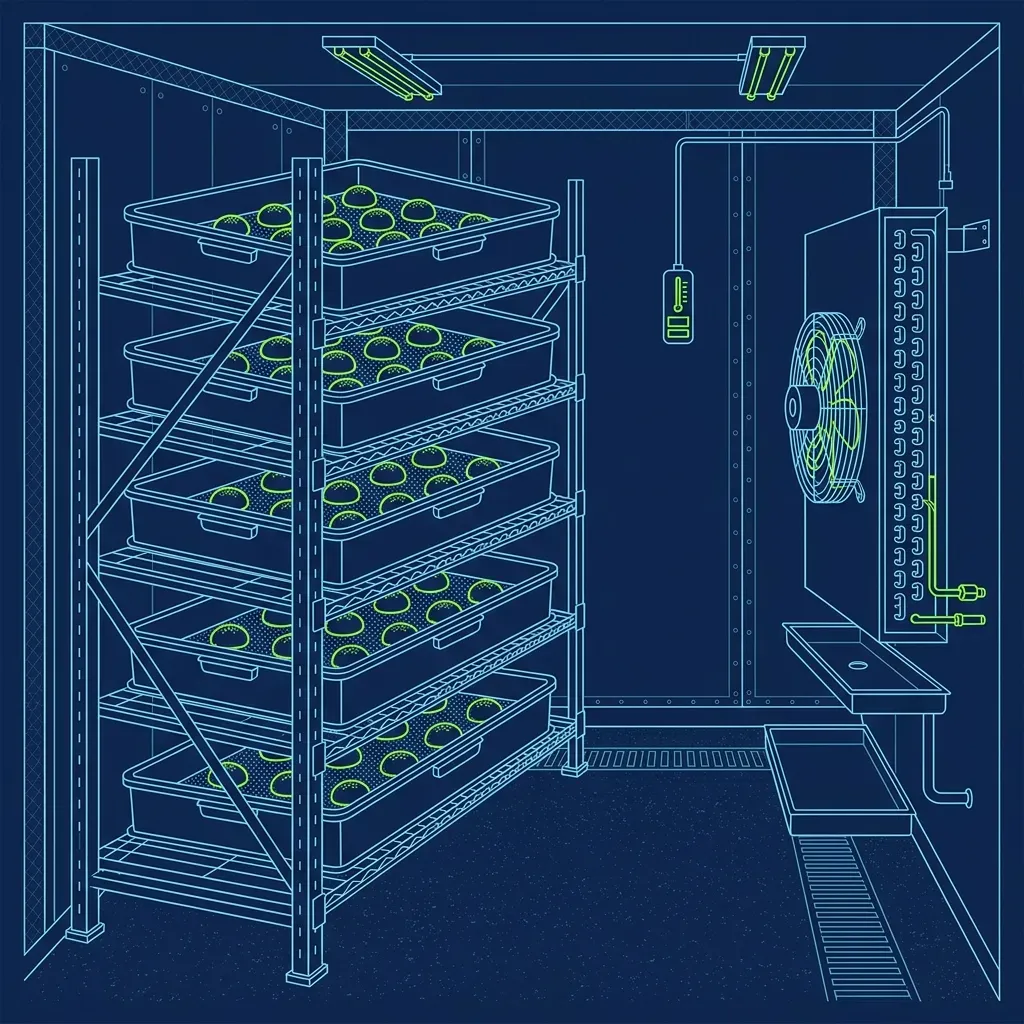
Before anyone slaps anything, the dough has to be properly managed. Papa John’s dough is delivered fresh — not frozen — in massive plastic trays stacked inside the walk-in cooler. Before it can be used, it has to be “proofed,” which means pulled from the cooler and allowed to rise at room temperature until the yeast activates and the gluten relaxes.
When an order comes in, the pizza maker pulls a dough ball from the proofing tray and drops it into a container of Dustinator — Papa John’s proprietary blend of mostly cornmeal and flour that prevents the wet dough from sticking to your hands, the table, or the pizza screen. If you’ve ever seen that fine yellowish powder coating the bottom of a Papa John’s crust, that’s Dustinator.
Here’s the thing nobody tells you about proofing: proper proofing is the single biggest factor in whether your slap succeeds or fails, and it has nothing to do with your technique. If the dough is pulled straight from the cooler and hasn’t had enough time to warm up, it will be stiff and rubbery. You’ll fight it the entire time, and the center will keep snapping back like a rubber band — no amount of slapping will fix under-proofed dough. On the other hand, if the dough sits out too long and over-proofs, it becomes sticky, floppy, and nearly impossible to handle without tearing holes.
Most stores pull dough trays from the cooler in staggered batches throughout the day so there’s always a tray at the perfect proofing stage. Managing this rotation is one of the opening manager’s most important responsibilities, and a botched proof schedule can derail an entire evening’s production.
The Edge Stretch and the Slap
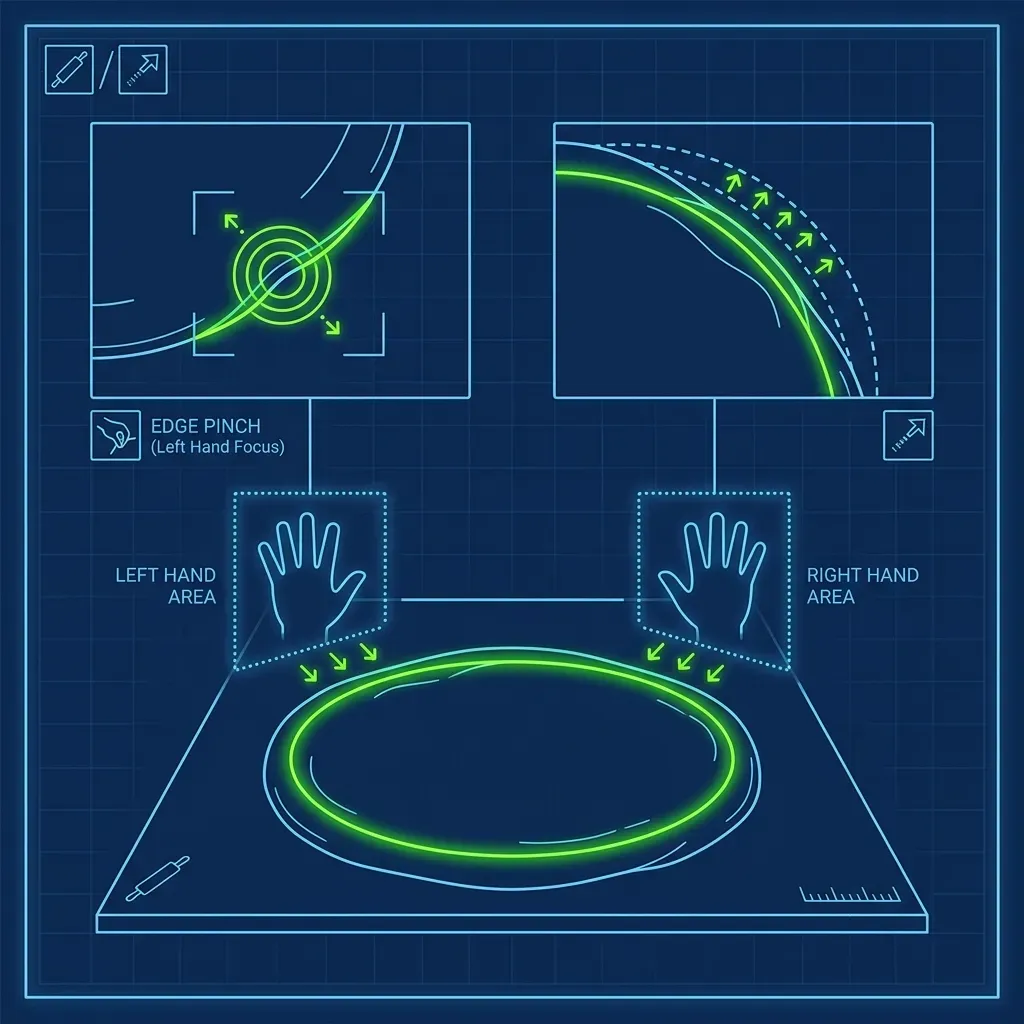
You have approximately 30 seconds to turn a dense dough ball into a perfect 14-inch circle without making the center too thin. The technique happens in two distinct phases:
Phase 1 — The Edge Stretch: You press your fingertips into the dough ball, working your way around the absolute outer edge to form the raised crust ring. The critical rule here is that you leave the center completely puffy and untouched. The edge stretch creates the structural border that will hold toppings in; if you skip it or rush it, the finished pizza will have sauce and cheese running off the edges in the oven.
Phase 2 — The Slap: You pick up the dough by the crust edge with both hands. Then you rapidly pass it back and forth between your open palms, slapping it down onto the stainless steel prep table with each transfer. As you slap it from your left hand to your right, you rotate it slightly — maybe 15 to 20 degrees per pass. The weight of the dough pulling downward with each slap naturally stretches the center out with perfectly even thickness.
If you do it right, the dough makes a loud, satisfying, rhythmic sound against the table. Experienced Insiders describe the feeling as almost meditative once it clicks — your hands move on autopilot, the rotation becomes instinctive, and the dough opens up into a perfect circle like it was always meant to be that shape.
If you do it wrong, you punch a hole directly through the middle and have to throw the entire dough ball away and start over. There’s no patching a torn pizza dough — the gluten structure is compromised, and it would bake unevenly.
Common Beginner Mistakes
Almost every new Insider goes through the same painful learning curve during their first week. I’ve watched hundreds of new hires learn this technique, and these are the mistakes you will almost certainly make:
- Slapping too aggressively: New hires tend to slam the dough down with their full arm strength, thinking it needs a hard impact to stretch. The reality is that the slap should be controlled and rhythmic — you’re letting gravity and the dough’s own weight do most of the work. Hitting it too hard creates thin spots in the center that tear during baking and leave you with a pizza that looks like it has a blowout.
- Forgetting to rotate: If you slap the dough back and forth without rotating it slightly with each pass, you end up with an oval instead of a circle. The rotation is what keeps the stretch even on all sides. I tell new hires to think of it like turning a steering wheel — small, consistent adjustments with every pass.
- Skimping on the Dustinator: New employees are sometimes stingy with the cornmeal blend because it makes a mess on the floor and the prep table. But under-dusting the dough means it sticks to the table, your hands, or the pizza screen — and a stuck dough is almost always a ruined dough. Be generous with the Dustinator and clean up the mess later.
- Touching the center too early: The center of the dough should stay puffy until the slapping process naturally stretches it out. If you press down on the center with your palms during the Edge Stretch, you create a paper-thin middle that either burns in the oven or collapses under the weight of the toppings, leaving you with a soggy, drooping center that customers send back.
The Speed Expectation on a Busy Night
During a busy Friday or Saturday night, the makeline at Papa John’s is relentless. Orders stack up on the screen, the phone doesn’t stop ringing, and the oven tender equivalent at the cut table is calling for pizzas faster than you can make them. A skilled Insider is expected to slap a dough, sauce it, cheese it, and top it in roughly 45 to 60 seconds per pizza. That means the slap itself has to be nearly automatic — you can’t afford to spend a full minute wrestling with a single dough ball when there are twelve orders on the screen.
Veteran pizza makers can slap out a perfect 14-inch crust in about 15 seconds flat. Getting to that speed takes weeks of practice, but once it clicks, it becomes pure muscle memory. Many experienced Insiders describe it as one of the most satisfying physical skills they’ve ever learned — there’s something deeply gratifying about watching a formless dough ball become a perfect circle in your hands in the time it takes to say a sentence.
The speed requirement changes with pizza size. A small 10-inch dough ball is lighter and stretches faster with fewer passes. A large 16-inch or extra-large requires more passes, a wider arm swing, and more Dustinator because there’s more surface area to manage. Most Insiders learn on the standard 14-inch first and then adapt to other sizes.
The Dough Slap vs. The Machine
Some Papa John’s franchises have adopted the Dough Spinner machine, which mechanically presses the dough flat using a heated press. The machine is faster, more consistent, and eliminates most of the human error from the stretching process. But it also produces a noticeably different crust — slightly denser, less airy, with a more uniform thickness that some customers and employees describe as less “artisan.”
Many locations still use the traditional hand-slap method, and corporate has not mandated the machine across all stores. Among veteran Insiders, the hand-slap is still considered the gold standard for crust quality. There’s a genuine debate within the chain about whether the consistency gains from the machine outweigh the quality difference, and franchise owners fall on both sides. If you’re applying to Papa John’s and want to learn the slap, ask during your interview whether the location uses hand-slap or the spinner — it’s a very different job experience.
Operations like Little Caesars with their Sheetout machine have fully automated the dough process, but Papa John’s has resisted going that far, and the hand-slap remains a point of pride for the brand.
Pro Tips for Learning the Slap
- Practice with cold dough during slow shifts. Ask your manager if you can use a couple of extra dough balls to practice when orders are light. Cold dough is harder to work with, so if you can slap cold dough without tearing it, properly proofed dough will feel effortless by comparison.
- Watch the shape of the dough, not your hands. Beginners stare at their palms during the slap. Experienced Insiders keep their eyes on the outer edge of the dough disc. If you see one side stretching faster than the other, you adjust your rotation angle on the next pass. Your hands should move on feel; your eyes should monitor the shape.
- Keep your prep table clean and re-dust between every pizza. Old flour, sauce residue, and grease on the table create sticky patches that can grab the dough mid-slap and tear it. A quick wipe and a fresh sprinkle of Dustinator between each pizza saves you from wasted dough balls and frustrated redo’s.
Frequently Asked Questions
How many dough balls does a new employee usually ruin before getting the technique down?
Most new Insiders tear or punch holes in somewhere between 5 and 15 dough balls during their first couple of training shifts. Managers expect this and budget for a small amount of dough waste during training. By the end of the first week, most people have the basic technique down enough to produce usable crusts consistently, even if they’re not yet fast.
What happens to dough that gets torn or messed up?
Torn dough goes straight into the waste bin. You cannot re-ball it or patch the hole because the gluten structure has been compromised, and it would bake unevenly with a different texture in the patched area. Every wasted dough ball is lost revenue, which is why managers emphasize proper technique and proper proofing management — both reduce waste.
Is the Dough Slap being replaced by machines everywhere?
Not yet. Some franchise locations have adopted the Dough Spinner machine, but many still use the traditional hand-slap. Corporate has not issued a chain-wide mandate for the machine. The hand-slap remains the preferred method at many locations, particularly those where the franchise owner values the artisan quality difference. If you’re interviewing at Papa John’s, it’s worth asking which method your location uses.