McDonald's Ice Cream Machine: Why It's Broken
It’s Not Actually Broken (Most of the Time)
The McDonald’s ice cream machine meme has taken on a life of its own. There’s even a How Are McDonald’s Chicken McNuggets Actually Made?)*
Russell’s Note: The Sysco truck being late will ruin a prep shift faster than anything else. You learn to pivot immediately or the lunch rush will crush you.
Russell’s Note: Time to lean, time to clean. It’s an annoying cliché, but when the health inspector (the ultimate clipboard warrior) shows up unannounced, you’ll be glad you wiped down the low-boys.
The machine usually isn’t broken. It’s locked. The vast majority of the time when a McDonald’s crew member tells you the ice cream machine is down, what they really mean is that the machine is in the middle of its automated heat pasteurization cycle and physically cannot dispense product until the cycle completes.
That cycle takes up to 4 hours, and if anything interrupts it — a power flicker, a temperature sensor reading slightly off, someone opening the wrong door — the machine throws an error code and the entire cycle has to start over.
The Machine: Taylor C709
Nearly every McDonald’s location in the United States uses the Taylor C709 soft-serve/shake machine. This is a commercial unit that costs approximately $18,000–$20,000 and is specifically engineered for high-volume soft-serve dispensing.
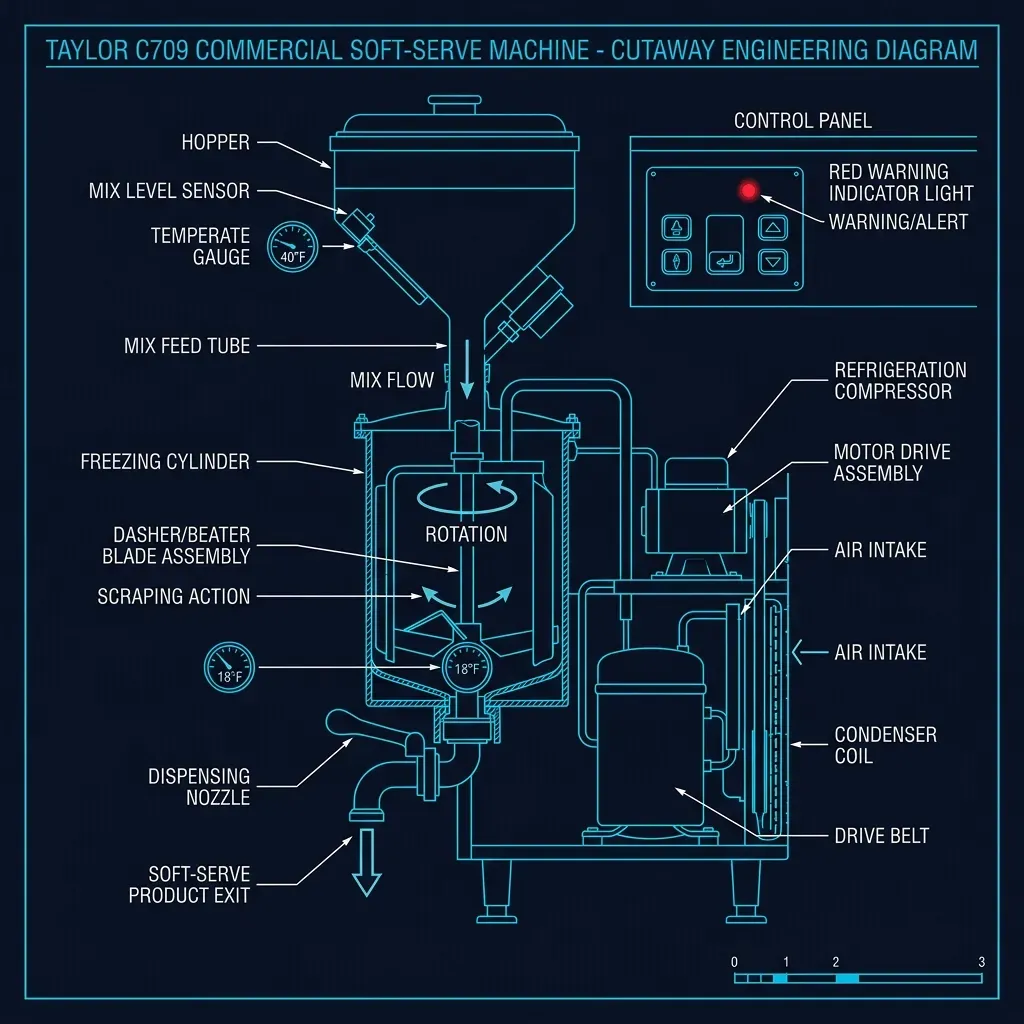
Here’s what’s inside:
How It Works
- The hopper sits on top and holds the liquid ice cream mix (a dairy-based liquid that arrives pre-mixed from the supplier) at approximately 40°F
- The mix feeds down into a freezing cylinder — a barrel surrounded by refrigerant coils
- Inside the cylinder, a rotating dasher blade (also called a beater) constantly scrapes the mix off the frozen walls, incorporating air as it goes
- The scraping and air incorporation turn the liquid mix into soft-serve at approximately 18°F
- The finished product is dispensed through a nozzle at the front of the machine
The air incorporation is critical. Soft-serve is typically 30–60% air by volume — this is called overrun. Without the right amount of air, the product would be too dense and icy. Too much air and it would be foamy and melt instantly.
The Heat Cycle: Why the Machine Locks Itself
Here’s the core problem. The Taylor C709 is required by food safety regulations to pasteurize its own contents on a regular basis. The ice cream mix is a dairy product sitting at temperatures that could allow bacterial growth if not properly managed.
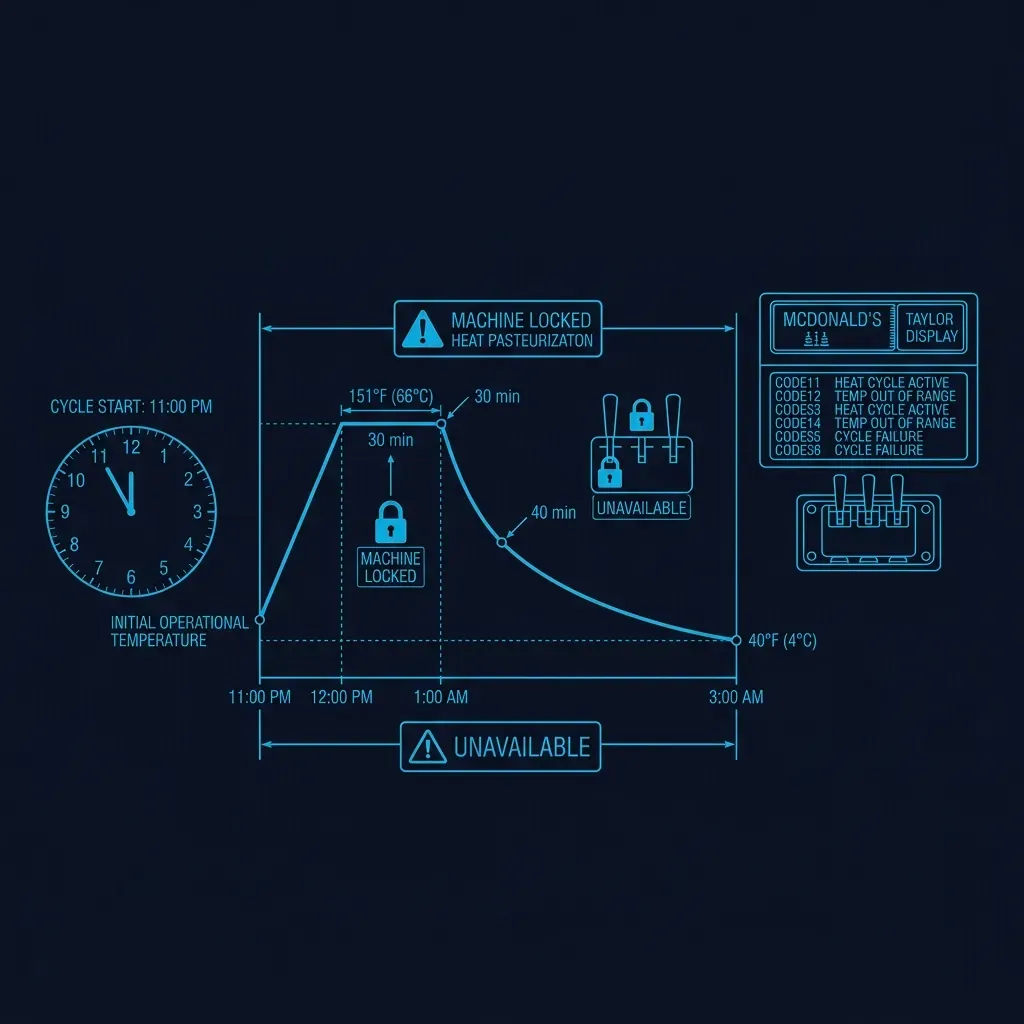
To handle this, the machine runs an automated heat pasteurization cycle, typically every night:
- Around 11 PM (timing varies by location), the machine automatically begins heating the mix inside the cylinder to 151°F
- It holds that temperature for 30 minutes to kill any potential bacteria
- It then slowly cools the mix back down to safe serving temperature (~40°F in the hopper, ~18°F at the barrel)
- The entire process takes approximately 2 to 4 hours
During this entire cycle, the machine cannot dispense product. The control panel locks out the dispensing function. If a crew member tries to override it, the machine throws an error.
When Things Go Wrong
The heat cycle is where most “breakdowns” actually happen. The cycle can fail if:
- A temperature sensor reads incorrectly — even a 1-2 degree deviation can trigger a fault
- Power fluctuates during the cycle — a brief outage resets the process
- The mix level is too low — the machine won’t complete the cycle if there isn’t enough product in the hopper
- Someone opens the machine during the cycle — this can interrupt the temperature hold
- The ambient temperature in the kitchen is too high — the machine struggles to cool back down
When the cycle fails, the machine displays a cryptic error code (like “ERROR 32” or a series of flashing lights) that most crew members have no idea how to interpret. The error codes are not intuitive — they’re designed for trained Taylor technicians, not 17-year-old crew members.
The Error Code Problem
This is where the story gets genuinely problematic. The Taylor C709’s error codes are:
- Displayed as numeric codes with no plain-English explanation on the machine itself
- Not fully documented in the basic operator manual that McDonald’s provides to franchisees
- Intentionally obscure, according to critics, because Taylor profits from repair visits
A typical interaction goes like this:
- Crew member arrives for morning shift, sees error code on the machine
- They check the basic troubleshooting card posted on the wall
- The card says “Call Taylor service” for anything beyond basic errors
- Taylor dispatches a technician — at $300–$500 per visit — sometimes for an issue as simple as “the mix was low during the heat cycle”
The Repair Monopoly
This is the part that made national news. Taylor has historically required that only authorized Taylor technicians service the C709. McDonald’s franchise agreements reinforce this — using unauthorized repair services can void the machine’s warranty.
The result is a system where:
- Franchise owners pay $18,000+ for the machine and then $300–$500 per service call
- Taylor technicians are often booked days out, leaving the machine down for extended periods
- Simple fixes (resetting the heat cycle, adjusting a sensor, topping off the mix) require waiting for a technician rather than being handled in-house
A company called Kytch developed an aftermarket device that plugged into the Taylor machine’s internal diagnostic port and translated the error codes into plain English on an app, allowing franchise operators to troubleshoot issues themselves. Taylor and McDonald’s corporate took legal action to block Kytch’s device, leading to a federal lawsuit and an FTC investigation into whether Taylor was engaging in anti-competitive repair practices.
What Crew Members Actually Deal With
From the crew’s perspective, the ice cream machine is the single most frustrating piece of equipment in the restaurant. Here’s a typical day:
Morning Shift (5-6 AM)
- Check the machine. If the heat cycle completed successfully overnight, the machine should be ready to serve by opening
- If the cycle failed (which happens regularly), the machine displays an error and needs to be reset — which means running the heat cycle again, taking another 2–4 hours
- This is why the machine is often “broken” during breakfast and early lunch
During Service
- The machine runs continuously, dispensing soft-serve cones, McFlurries, and sundaes
- The hopper needs to be refilled with mix periodically — each bag of mix yields roughly 50–80 cones depending on portion size
- If the hopper runs dry during service, the machine can overheat the remaining product and trigger an automatic shutdown
Late Night
- The machine begins its heat cycle. If a late-night customer orders ice cream during the cycle, the answer is “the machine is down”
- Crew members who close learn to stop selling ice cream 30–60 minutes before the heat cycle starts to avoid partially-full orders
Why McDonald’s Doesn’t Just Use a Different Machine
This is the question everyone asks. The answer is contractual and logistical:
- McDonald’s has a national contract with Taylor that covers all US locations. Switching vendors would require renegotiating agreements with 13,000+ franchise operators
- The Taylor C709 is genuinely good at what it does when it’s working. It produces consistent soft-serve at high volume. The problem is the maintenance burden, not the product quality
- Supply chain integration — McDonald’s ice cream mix, cups, cone sleeves, and McFlurry equipment are all designed around the Taylor machine’s specifications
- Capital cost — replacing 13,000+ machines at $18,000–$20,000 each would cost over $250 million
So the machine stays. And the meme lives on.
What “Broken” Actually Means
Next time a McDonald’s crew member tells you the ice cream machine is broken, here’s what’s probably actually happening:
- 60% of the time: The machine is in its heat pasteurization cycle or recovering from a failed cycle
- 20% of the time: The mix hopper is empty and hasn’t been refilled yet
- 10% of the time: An error code is displayed and the crew doesn’t know how to clear it
- 10% of the time: The machine is actually broken and waiting for a Taylor technician
The ice cream itself, when you can get it, is exactly the same product it’s been for decades — a simple vanilla soft-serve that is objectively unremarkable but somehow tastes better when you had to check three locations to find a working machine.