The Secret to Rolling a Massive Double-Meat Chipotle Burrito
If you have ever ordered a burrito at Chipotle with double chicken, extra white rice, black beans, queso, both salsas, sour cream, cheese, and guacamole, you have handed the line worker a ticking time bomb. They’re looking at a tortilla that’s about to be asked to contain roughly two pounds of filling, and the margin for error is approximately zero.
Rolling a burrito of that magnitude without it splitting open is genuinely an art form. I’ve seen line workers with years of experience pause for a half-second and take a breath before attempting a monster order like that. And I’ve seen new hires watch in horror as guacamole explodes out the side of a tortilla in front of a full line of customers. Here’s the technique that separates the pros from the casualties.
Step 1: The U-Shape Placement
Russell’s Note: Time to lean, time to clean. It’s an annoying cliché, but when the health inspector (the ultimate clipboard warrior) shows up unannounced, you’ll be glad you wiped down the low-boys.
Russell’s Note: The Sysco truck being late will ruin a prep shift faster than anything else. You learn to pivot immediately or the lunch rush will crush you.
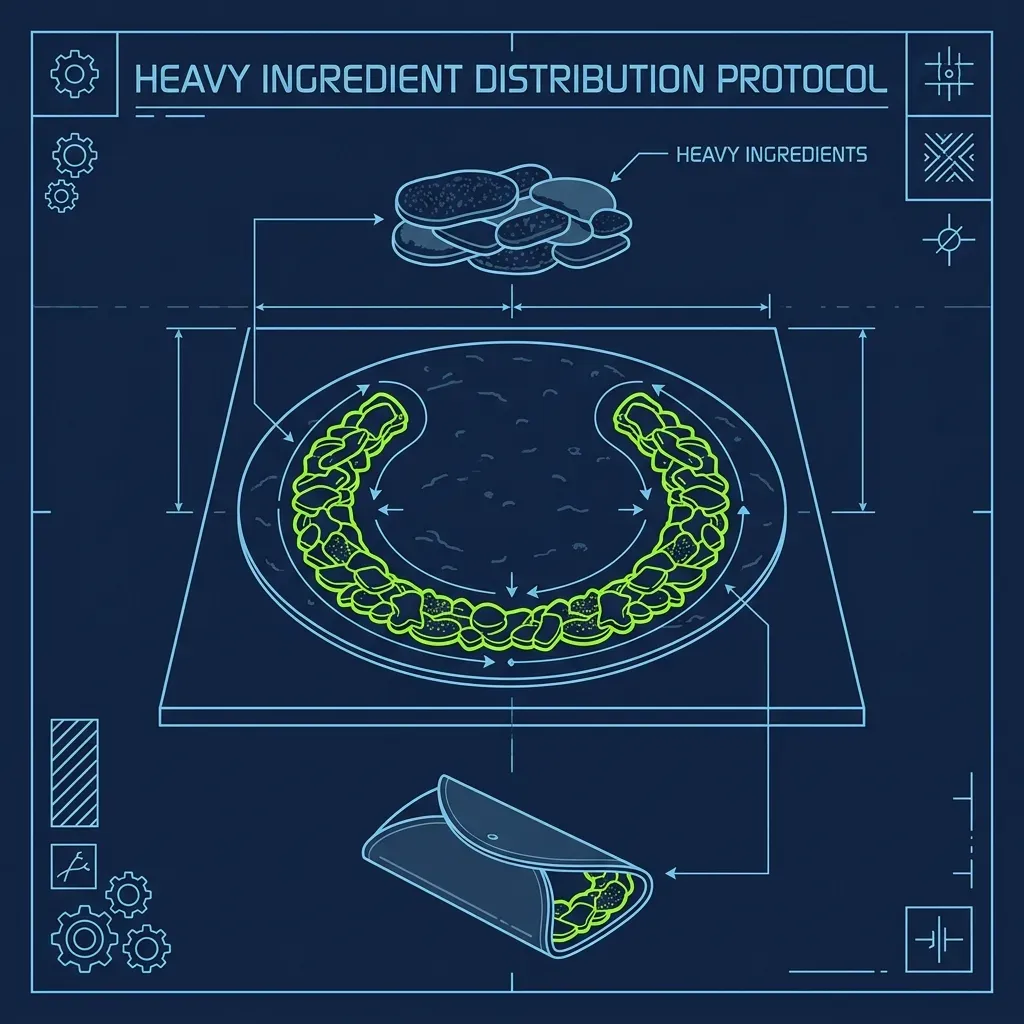
The roll actually starts before you even touch the tortilla edges. When you’re adding ingredients, do not pile them into a massive mountain in the dead center. That’s the instinct, and it’s wrong.
You must spread the ingredients out into a thick line, forming a slight “U” or boat shape in the bottom third of the tortilla. This distributes the mass across a wider area and gives you actual room to work with when the fold starts.
Here’s the thing nobody tells you during training: the order you layer ingredients matters enormously for structural integrity. Heavier, denser items like rice and beans go down first, forming a stable base layer. They’re your foundation. Wet items like salsa and sour cream get layered on top, never underneath. If salsa soaks into the tortilla before you even start rolling, you’re working with wet tissue paper. It will tear the instant you apply pressure during the tuck, and then you’re starting over.
I’ve watched new hires dump hot salsa directly onto the center of the tortilla, then pile everything on top. By the time they go to roll, there’s a translucent wet spot in the middle of the flour tortilla that might as well be a hole. The burrito was dead before they even touched it.
Step 2: The Stretch and Tuck
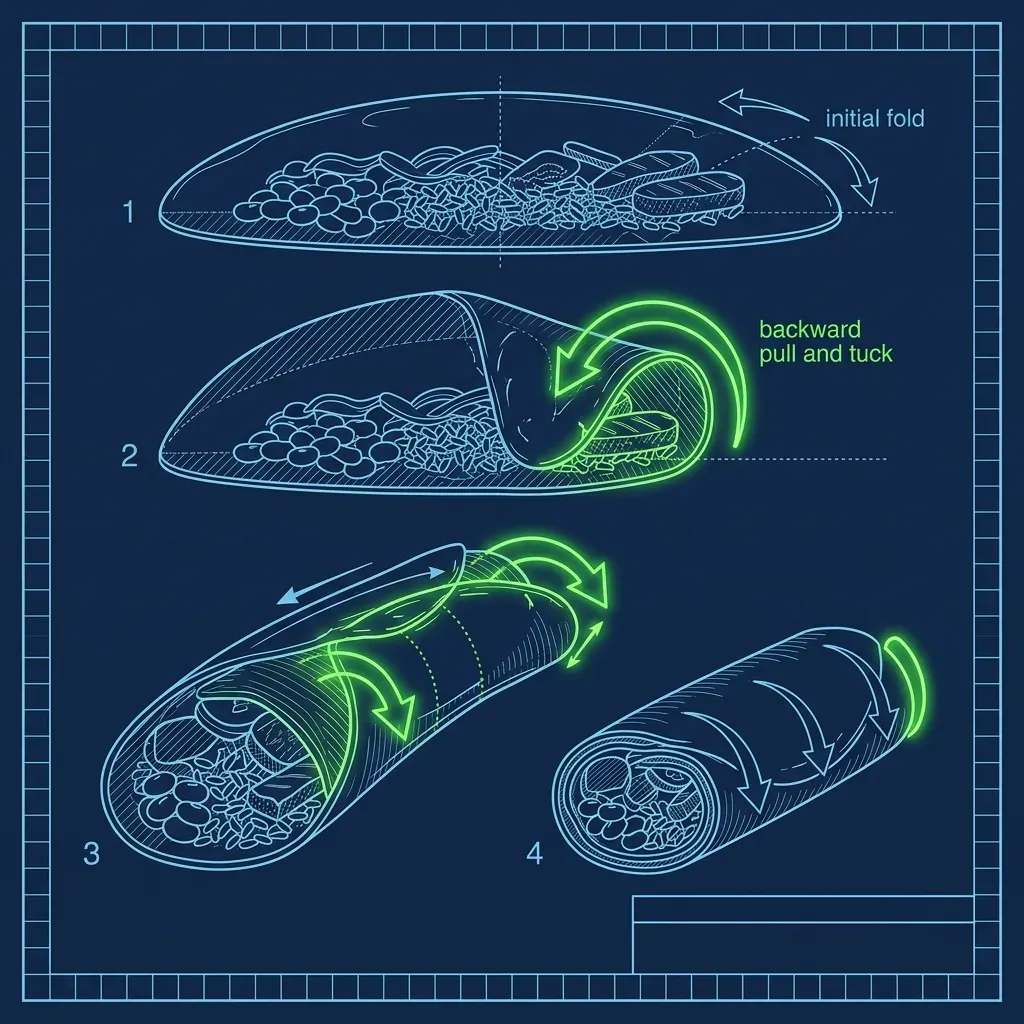
This is where burritos live or die. Do not try to fold it like a Christmas present. The Chipotle roll is a specific four-part motion:
-
The Pinch: Grab the left and right sides of the tortilla and pull them together, pinching them slightly so the ingredients are trapped in the middle. This contains the lateral spread.
-
The Roll-Over: Using your thumbs, bring the bottom flap of the tortilla up and over the entire pile of food. You want the edge of the tortilla to make contact with the filling.
-
The Pull-Back: This is the secret—the move that separates a tight burrito from a loose one. Once the top flap is over the food, use your pinkies to tuck the tortilla under the food, and pull the entire massive cylinder backward toward your body. You are physically compressing the ingredients into a tight, dense log. This is the step where you apply real pressure.
-
The Final Roll: Keeping that intense backward tension, roll the cylinder forward until the final flap of the tortilla wraps underneath the burrito, seam-side down.
The pull-back step is where most new employees fail. They are terrified to apply real pressure because they think the tortilla will tear. But here’s the reality: a properly warmed tortilla has significant elasticity. It can stretch and compress far more than you’d expect. The problem is actually the opposite—if you don’t pull back hard enough, the burrito stays loose, and the ingredients shift and push against the tortilla from the inside, causing it to blow out at the ends like a tube of toothpaste.
Commit to the pull-back. It feels aggressive. It’s supposed to.
Step 3: The Foil Wrap
The aluminum foil is not decorative. It provides genuine structural integrity, and if the tortilla suffered a micro-tear during the roll, the foil is what saves the entire burrito from disintegrating in the customer’s hands.
Place the burrito diagonally on the foil—at roughly a 45-degree angle—and roll it incredibly tight, folding the edges of the foil inward as you go. The diagonal placement is critical. If you place the burrito straight across the foil, you will run out of material on the ends and the foil won’t fully cover both sides. The 45-degree angle gives you maximum coverage, creating a sealed package that holds everything together even if the tortilla is compromised underneath.
I used to tell my line workers: the foil wrap is your insurance policy. Even a perfect roll can have a hidden weak point. The foil catches it.
The Double-Wrap: When to Deploy It
Here’s where experience separates you from the new hires. If a customer orders double meat, extra of every wet topping, queso, and guacamole, you should already be reaching for a second tortilla before they finish ordering. The double-wrap—slapping a second warm tortilla underneath the first—gives you the structural thickness needed to contain what is essentially burrito soup.
The double-wrap is not a failure. It is a tool. Proactively offering it shows confidence and saves everyone the embarrassment of a burrito detonating mid-roll in front of a full line of customers. Experienced line workers recognize the need for a double-wrap based on the order alone, before a single ingredient hits the tortilla. And no, Chipotle does not charge extra for the double-wrap—it’s considered a standard accommodation, not an add-on.
The tortilla press matters here, too. A few extra seconds on the press is the single most effective thing you can do to prevent tears across the board. Press it until you see light brown grill marks and the tortilla feels pliable and warm to the touch. Never attempt to roll with a lukewarm or room-temperature tortilla. A cold tortilla is stiff and brittle. It will crack the moment you fold it. Every single tear I’ve diagnosed on the line traced back to either a cold tortilla or a soggy center. Fix those two things and your blow-out rate drops to nearly zero.
One more thing: wipe down your rolling surface between burritos. Residual salsa, sour cream, or queso from the previous roll makes the foil and tortilla slide instead of grip, making it nearly impossible to achieve the tight roll you need. A clean, dry surface gives you traction. Traction gives you control.
For more on the prep side of Chipotle operations, check out The Strict Science of the Chipotle Fajita Veggie Cut and What Actually Happens During Grill Validation. And if you’re curious how other chains handle their own wrapping challenges, Subway’s Wrap Folding Technique is a completely different beast.
Frequently Asked Questions
What is the most common reason a burrito tears during the roll?
A cold tortilla. If the tortilla was not properly warmed on the press, it will be stiff and brittle, and it will crack the moment you try to fold it. A properly heated tortilla is soft, flexible, and slightly stretchy. If you pick up a tortilla and it feels rigid, send it back to the press for a few more seconds before loading it with ingredients. The second most common cause is a soggy center from wet toppings being placed directly on the tortilla instead of on top of the rice and bean base.
Does Chipotle charge extra for a double-wrapped burrito?
No. The double-wrap—adding a second tortilla—is completely free of charge. It is considered a standard accommodation, not an add-on. Customers can request it, or the line worker can suggest it when the filling volume clearly exceeds what a single tortilla can safely handle. There is no reason to hesitate about offering it.
Is there a maximum amount of ingredients a burrito can hold?
There is no official maximum, but there is absolutely a practical limit. Once a burrito has double meat, all the toppings, and extras of several items, even a double-wrapped tortilla struggles to contain it. At that point, many experienced line workers will gently suggest a bowl, since the customer gets the exact same food in the exact same quantity without the risk of structural failure and a lap full of queso.