Bojangles Biscuit Process: Made From Scratch
The Hardest Job in the Kitchen
Every fast-food restaurant has a position nobody wants during a rush. The fry station when tickets are stacking. The drive-through window when the headset is cutting out. But at Bojangles, there is one role that stands above everything else in terms of difficulty, pressure, and pure physical output: the Biscuit Maker.
Russell’s Note: You don’t know true panic until a 15-item catering order drops right in the middle of a Sunday brunch shift. It instantly backs you up to the window.
Russell’s Note: I’ve got faded burn scars from exactly this kind of setup. If you aren’t communicating with ‘Behind!’ and ‘Hot!’, you’re going to get someone hurt.
This isn’t a glorified “pop the tray in the oven” gig. The Biscuit Maker is responsible for producing every single biscuit from scratch — flour, shortening, buttermilk, hands, oven — on a rolling cycle that never stops from the moment they clock in until the breakfast window closes. There are no frozen pucks. No par-baked shortcuts. If the Biscuit Maker doesn’t show up, the store essentially doesn’t open.
I managed multiple Bojangles locations over several years, and I can tell you without hesitation: the Biscuit Maker position is harder than anything I’ve seen at other chains. That includes the Hardee’s biscuit maker shift, which is grueling in its own right, and Chick-fil-A’s breading process, which demands serious consistency. But neither of those roles carries the same combination of speed, technique, and sheer volume that Bojangles demands.
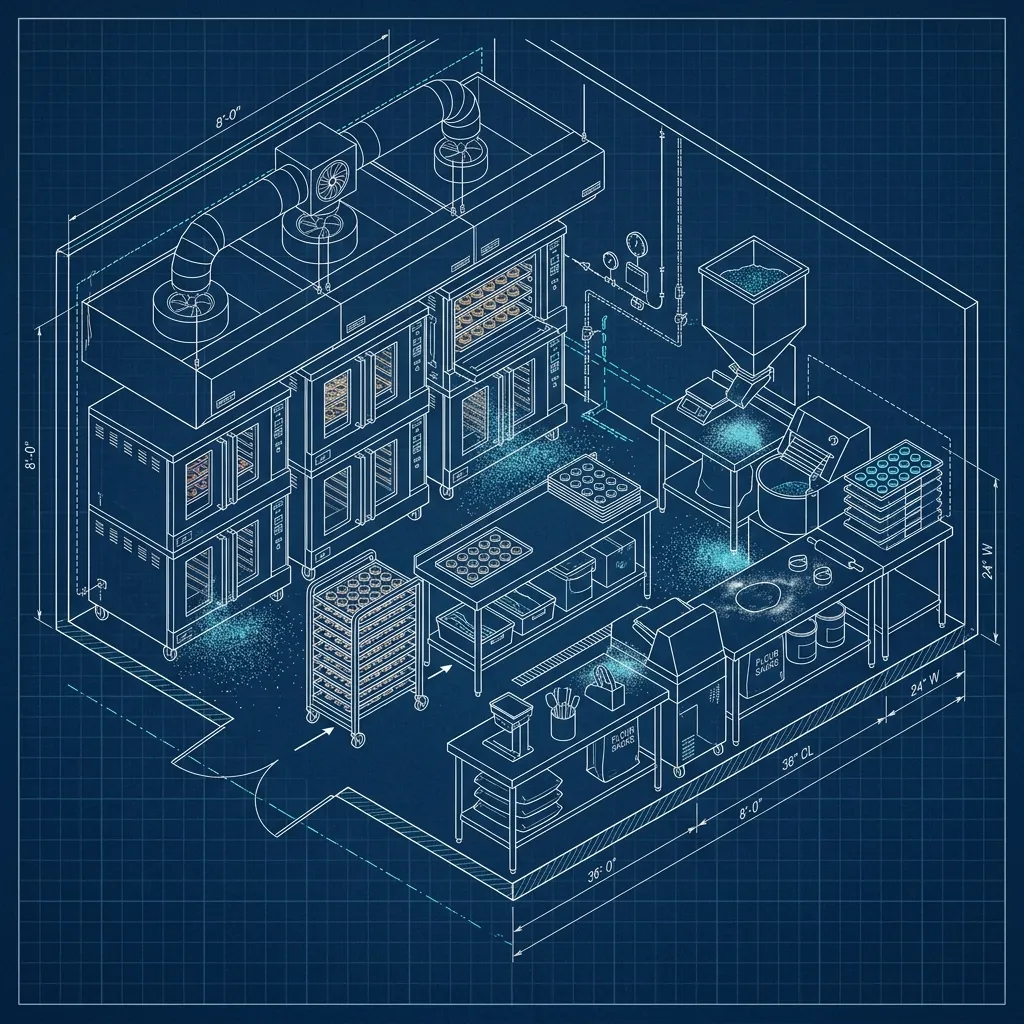
The 4:00 AM Arrival
The Biscuit Maker’s day starts while most people are still asleep. At most locations, the biscuit person clocks in at 4:00 AM — sometimes earlier depending on the store’s opening time. Most Bojangles locations open between 5:30 and 6:00 AM, and the doors do not open until biscuits are ready and on the line. Period.
Here’s what that first hour looks like:
- 4:00 AM — Clock in, wash hands, put on apron. Pull the proprietary flour from dry storage. Grab the shortening. Get the buttermilk out of the walk-in cooler and make sure it’s ice-cold.
- 4:05–4:15 AM — Set up the biscuit station. This means sanitizing the cutting surface, laying out the rolling pin (the one with the thickness guides on the ends), positioning the biscuit cutter, and preheating the oven to 425°F.
- 4:15–4:30 AM — First batch of dough gets mixed. Shortening cut into the flour by hand or with a low-speed mixer until it looks like coarse, pebbled crumbs. Cold buttermilk folded in. Dough turned out. Kneaded. Rolled. Cut. Placed on the sheet pan.
- 4:45–5:00 AM — First batch goes into the oven. The Biscuit Maker immediately starts mixing the second batch. By the time the first batch comes out golden and steaming, the second batch is ready to go in.
- 5:30–6:00 AM — Doors open. The line should have fresh biscuits sitting in the warmer, and more coming out of the oven within minutes. From this point forward, the Biscuit Maker is running on a continuous loop that won’t stop for hours.
The morning rush at a busy Bojangles can require 15–20+ batches of biscuits before 10:00 AM. That’s a staggering amount of dough mixed, rolled, cut, and baked by one person.
The Proprietary Flour Blend
One of the biggest misconceptions about Bojangles biscuits is that they’re made with regular all-purpose flour. They are absolutely not.
Bojangles uses a proprietary self-rising flour blend that comes pre-mixed from their own distribution network. This flour is built on soft winter wheat, which has a lower protein content than the hard wheat used in bread flour or standard AP flour. Lower protein means less gluten development, which means a more tender, crumbly biscuit that practically dissolves when you bite into it.
What’s In the Blend
The pre-blended flour already contains:
- Soft winter wheat flour — the base, chosen specifically for its low protein content (around 7–9% compared to 10–12% in AP flour)
- Leavening agents — baking powder and baking soda, pre-measured in the exact ratio Bojangles requires
- Salt — already incorporated so there’s no measuring error at the store level
This means the Biscuit Maker doesn’t have to measure leavening or salt separately. The flour arrives ready to go. All they need to add is shortening and buttermilk. This reduces the margin for error, but it also means the flour itself is the single most important ingredient. If distribution sends a bad batch — if the leavening ratio is off by even a small percentage — every biscuit in every store using that batch will be wrong. I’ve seen it happen. You can tell immediately.
The Buttermilk Soak Step
If the flour is the foundation, the buttermilk is the engine. And the single most important thing about the buttermilk is its temperature: it must be ice-cold. Not cool. Not room temperature. Cold enough that you feel it through the measuring container.
Why Cold Buttermilk Matters
There are two things happening when cold buttermilk hits that flour blend:
-
Chemical leavening reaction — The acid in the buttermilk reacts with the baking soda in the self-rising flour, producing carbon dioxide gas. This CO2 gets trapped in the dough and expands in the oven, creating lift and fluffiness. If the buttermilk is warm, this reaction starts too early — on the counter instead of in the oven — and you lose rise.
-
Fat preservation — The buttermilk contains fat, and that fat contributes to the biscuit’s tenderness. But more importantly, the cold temperature keeps the shortening in the dough from melting prematurely. You want solid chunks of shortening going into that oven. When they melt during baking, they create steam pockets — those are your flaky layers.
The Brief Soak
Some stores use what’s informally called a buttermilk “soak.” After the dough is mixed and gently brought together, it rests for just a brief moment — maybe 30 seconds to a minute — before the Biscuit Maker begins kneading and folding. This isn’t a long rest like you’d do with bread dough. It’s just enough time for the flour to hydrate evenly so you get a more consistent texture. Not every store does this, but the ones that do tend to produce a slightly more uniform biscuit.
Hand-Cutting vs. Stamping: The Technique That Makes or Breaks the Biscuit
This is where Bojangles separates itself from the McDonald’s and Burger Kings of the world. Bojangles uses a handheld biscuit cutter — a round, sharp-edged metal ring — not a hydraulic stamp press or a pre-formed mold.
The Golden Rule: Never Twist
The technique is simple to describe and incredibly hard to do consistently at speed:
- Dip the cutter in flour before every single cut. This prevents sticking and ensures a clean release.
- Push straight down through the dough with firm, even pressure.
- Pull straight up without any rotation whatsoever.
- Never, ever twist. Twisting the cutter smears and seals the edges of the dough layers together. Those layers are your entire rise mechanism — they’re created by the folding process and the chunks of solid shortening. Seal them shut, and your biscuit comes out flat, dense, and sad.
A properly cut Bojangles biscuit has visible, ragged layers on the sides. You can see them before it even goes into the oven. If the edges look smooth and sealed, the Biscuit Maker twisted, and those biscuits won’t rise right.
New Biscuit Makers twist instinctively. It takes weeks of repetition to break the habit. This is one of the main reasons the training process is so intensive — the 49-step certification isn’t a marketing gimmick. It exists because the margin between a perfect biscuit and a mediocre one is razor-thin, and muscle memory is the only thing that bridges the gap at production speed.
The Resting Period
Bojangles biscuits don’t go through a proof box — that’s a technique for yeast-risen doughs like dinner rolls or sandwich buns. Biscuits rely on chemical leavening (baking powder and baking soda), not yeast, so proofing isn’t part of the equation.
However, the freshly cut biscuits do get a brief rest at room temperature while the oven finishes preheating or between batch rotations. This window is usually about 3–5 minutes. During this time, the leavening agents are starting their initial reaction and the gluten is relaxing slightly from the cutting and handling. It’s a subtle step, but it contributes to a more even rise.
Oven Temperature and Rotation Schedule
Bojangles bakes their biscuits at 425°F — hot enough to get rapid oven spring (that initial burst of rise when the cold dough hits the heat) but not so hot that the outside burns before the inside cooks through.
The Bake
- Oven type — Most locations use either a rotating deck oven or a commercial convection oven. The rotating deck ovens are preferred because they provide more even heat distribution.
- Rotation — Halfway through the bake, the sheet pan is rotated 180 degrees. Even in a convection oven, there are hot spots. Rotating ensures both sides of the batch brown evenly.
- Total bake time — 12–16 minutes depending on the oven type, altitude, and how loaded the oven is. The Biscuit Maker checks for golden brown on both the top and the bottom. If the bottom is pale, they’re underdone. If the top is dark but the bottom is light, the oven has a heat distribution issue.
The finished biscuit should have a crisp, golden-brown exterior that yields immediately when you pull it apart, revealing soft, steaming, flaky layers inside. If it takes any real effort to tear open, the dough was overworked.
Why Bojangles Biscuits Taste Different From Competitors
People always ask me this. “Why do Bojangles biscuits taste so different?” It’s not one thing. It’s a combination of factors that most competitors either can’t or won’t replicate:
-
Higher shortening-to-flour ratio — Bojangles uses more fat relative to flour than most fast-food biscuit recipes. More fat means more flavor, more tenderness, and more distinct layers. You can taste the richness.
-
Hand-cutting creates irregular layers — Because the biscuits are cut by hand with a ring cutter (not stamped by a machine), the layers are uneven, organic, and unpredictable. This gives the biscuit a rustic, homemade texture that a perfectly uniform machine-stamped biscuit simply cannot achieve.
-
Softer flour blend — That proprietary soft winter wheat flour produces a fundamentally different texture than the harder wheat flours used by many competitors. It’s the difference between a biscuit that’s tender and one that’s chewy.
-
Made from scratch, every single batch — This is the big one. Bojangles does not use frozen biscuit dough. They don’t use par-baked pucks that get finished in the oven. Every biscuit starts as flour and shortening and buttermilk, mixed by hand, that morning, in that store. Most major fast-food chains gave up on from-scratch biscuits years ago because of the labor cost and consistency challenges. Bojangles kept going.
The 20-Minute Freshness Rule
Bojangles enforces a 20-minute hold time on biscuits. Once a biscuit comes out of the oven, it has exactly 20 minutes before it’s supposed to be pulled from the line and discarded.
This is aggressive. Most chains give their baked goods 30 minutes to an hour (or more). But biscuits lose their magic fast. After about 15 minutes, the exterior starts losing its crispness. By 25–30 minutes, the interior texture starts to shift from fluffy to dense. Bojangles draws the line at 20 minutes because they’d rather waste product than serve a subpar biscuit.
During a peak morning rush, this isn’t much of an issue — biscuits sell faster than they can be made. But during slower periods, the Biscuit Maker has to make judgment calls about batch sizes to minimize waste while still having fresh product available. It’s a constant balancing act.
The Master Biscuit Maker Competition
Every year, Bojangles holds a company-wide Master Biscuit Maker competition. Store-level winners advance through regional rounds and eventually compete at the national level. Contestants are judged on speed, technique, consistency, and the final product’s appearance and texture.
It sounds like a lighthearted corporate event, but the people who compete take it dead seriously. Winning the Master Biscuit Maker title is a genuine point of pride in the Bojangles system. These are the people who can turn out flawless biscuits at high speed without breaking a sweat — the kind of Biscuit Maker who makes the morning rush look effortless while everyone else on the line is barely holding it together.
The competition also serves a practical purpose: it reinforces Bojangles’ commitment to the from-scratch process. In an industry that’s constantly looking for ways to cut labor and automate, the Master Biscuit Maker competition is a very public statement that Bojangles still believes the human touch matters.
Are Bojangles Biscuits Made From Scratch?
Yes, 100%. Every Bojangles biscuit is made from scratch in the store, every single day. The Biscuit Maker combines proprietary self-rising flour, shortening, and ice-cold buttermilk by hand, rolls and cuts the dough with a biscuit cutter, and bakes them in-store. There are no frozen biscuit pucks, no par-baked dough shipped from a factory. This is one of the primary reasons Bojangles biscuits taste so different from competitors — and it’s also why the Biscuit Maker position is so demanding. The process requires a trained person on-site before dawn, producing continuous batches throughout the entire morning.
How Long Are Bojangles Biscuits Good For?
Officially, Bojangles enforces a 20-minute freshness window. Once a biscuit comes out of the oven, it should be served within 20 minutes or pulled from the line. After that threshold, the exterior loses its signature crispness and the interior begins to shift from light and fluffy to dense and starchy. During a busy morning rush, this is rarely an issue because biscuits sell as fast as they’re made. During slower periods, the Biscuit Maker adjusts batch sizes to reduce waste while keeping fresh product available. If you want the absolute best Bojangles biscuit, go during the peak of the breakfast rush — you’ll almost certainly get one straight out of the oven.
What Flour Does Bojangles Use?
Bojangles uses a proprietary self-rising flour blend that is distributed through their own supply chain. It is not standard all-purpose flour. The blend is built on soft winter wheat, which has a significantly lower protein content (around 7–9%) compared to all-purpose flour (10–12%). This lower protein means less gluten forms when the dough is mixed, resulting in a more tender, delicate crumb. The flour comes pre-blended with leavening agents (baking powder and baking soda) and salt already incorporated at precise ratios, so the Biscuit Maker only needs to add shortening and cold buttermilk. This consistency across the supply chain is how Bojangles maintains a uniform product across hundreds of locations while still making every biscuit from scratch.